GP economics|Briefing
Who pays the GP commitment?
“Two per cent, skin in the game” is where the question starts, not the answer. How much managers commit, and where that money really comes from.
Watch
The video
About eight minutes. Koi explains, Kai makes the GP’s case, Leo asks the LP’s questions.
 YouTube embed placeholder
What you’ll learn
By the end, you can
- Define the GP commitment and give today’s typical range, with the caveats on the data.
- Explain why LPs treat it as an alignment signal, and what it doesn’t prove.
- Name five ways GPs fund it, and how each changes the alignment.
- Work out a GP’s effective cash and own-money commitment after fee waivers and borrowing.
- Recap 2-and-20, the hurdle and the catch-up, and why headline fees understate the cost.
- Use a due-diligence checklist to question a GP commitment.
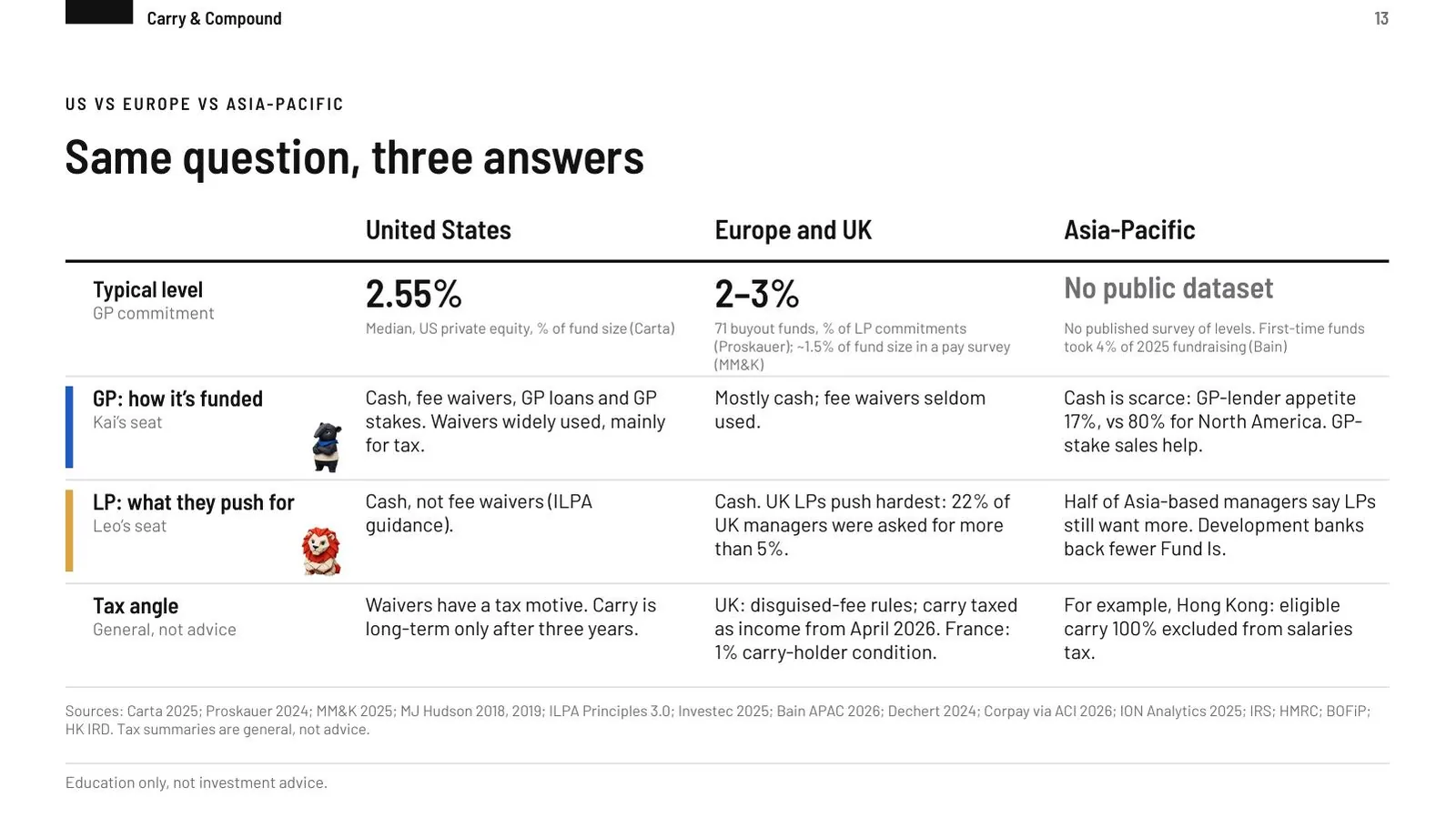
- Compare how commitments are sized, funded and negotiated in the US, Europe and Asia-Pacific.
The short version
The GP’s own money, in the fund, on the same terms
The GP commitment is the money a fund’s manager invests in its own fund, alongside the LPs and on the same terms. ILPA says the GP should hold “a substantial equity interest in the fund”, paid in cash rather than through fee waivers or special financing, and invested through the main fund rather than deal by deal.
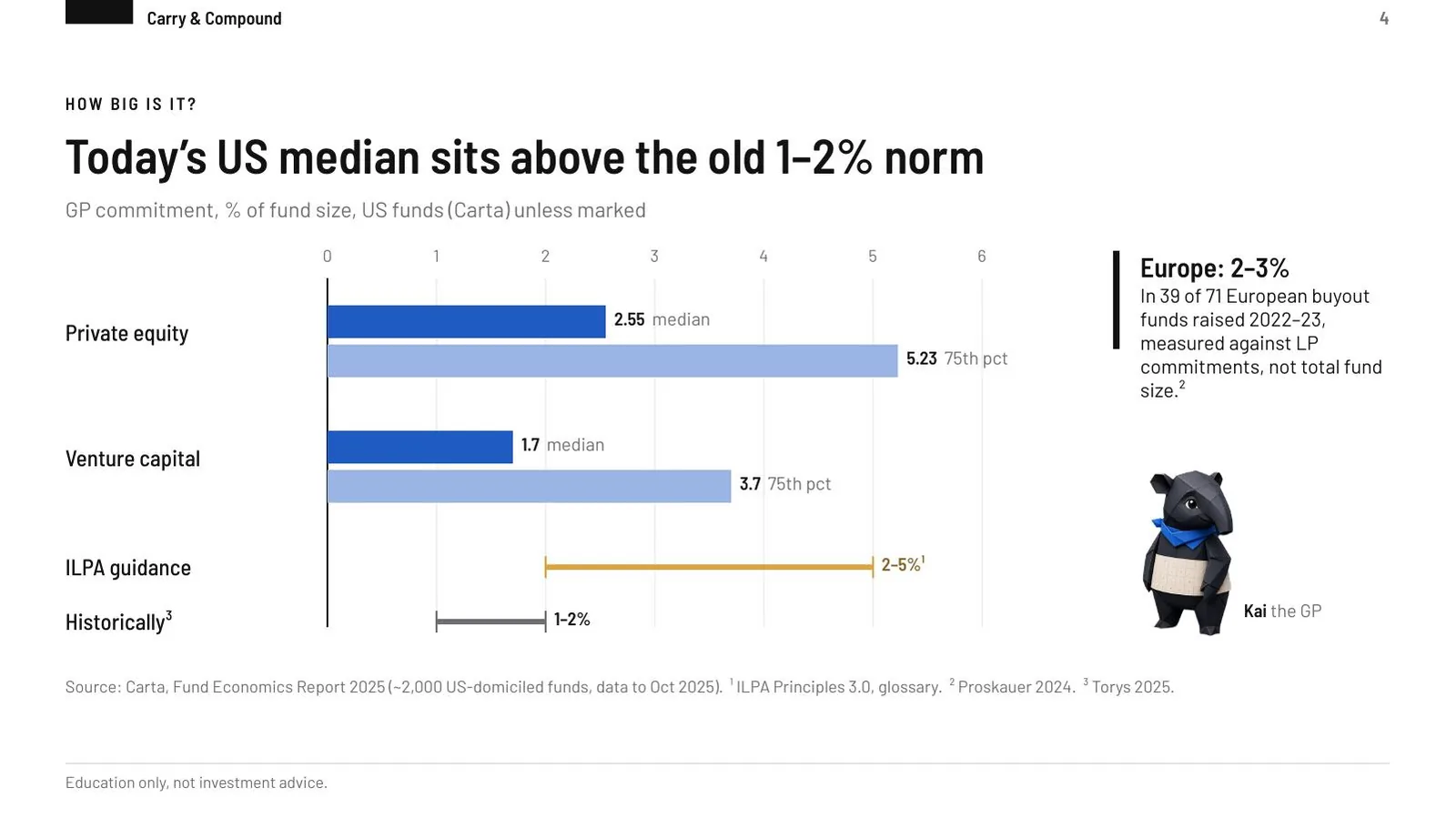
Historically, commitments hovered around 1–2% of fund size; today 2–4% is more typical, according to Torys. In Carta’s US data the median private equity commitment is 2.55% (75th percentile 5.23%) and the venture median is 1.7%. In Proskauer’s sample of 71 European buyout funds, 2% and 3% were the most common levels.
Read the fine print on “%”. Carta measures against total fund size (LP plus GP money). ILPA’s model terms and Proskauer measure against LP commitments. Same fund, different number.
Why LPs care
Management fees are paid whatever happens. In Metrick and Yasuda’s study of 238 funds, about 60% of a GP’s expected revenue came from fixed components that don’t depend on performance. The GP’s own money is the part that loses alongside the LPs, which is why investors look at it so closely.
Where Kai’s 2% comes from
Five ways to fund the commitment
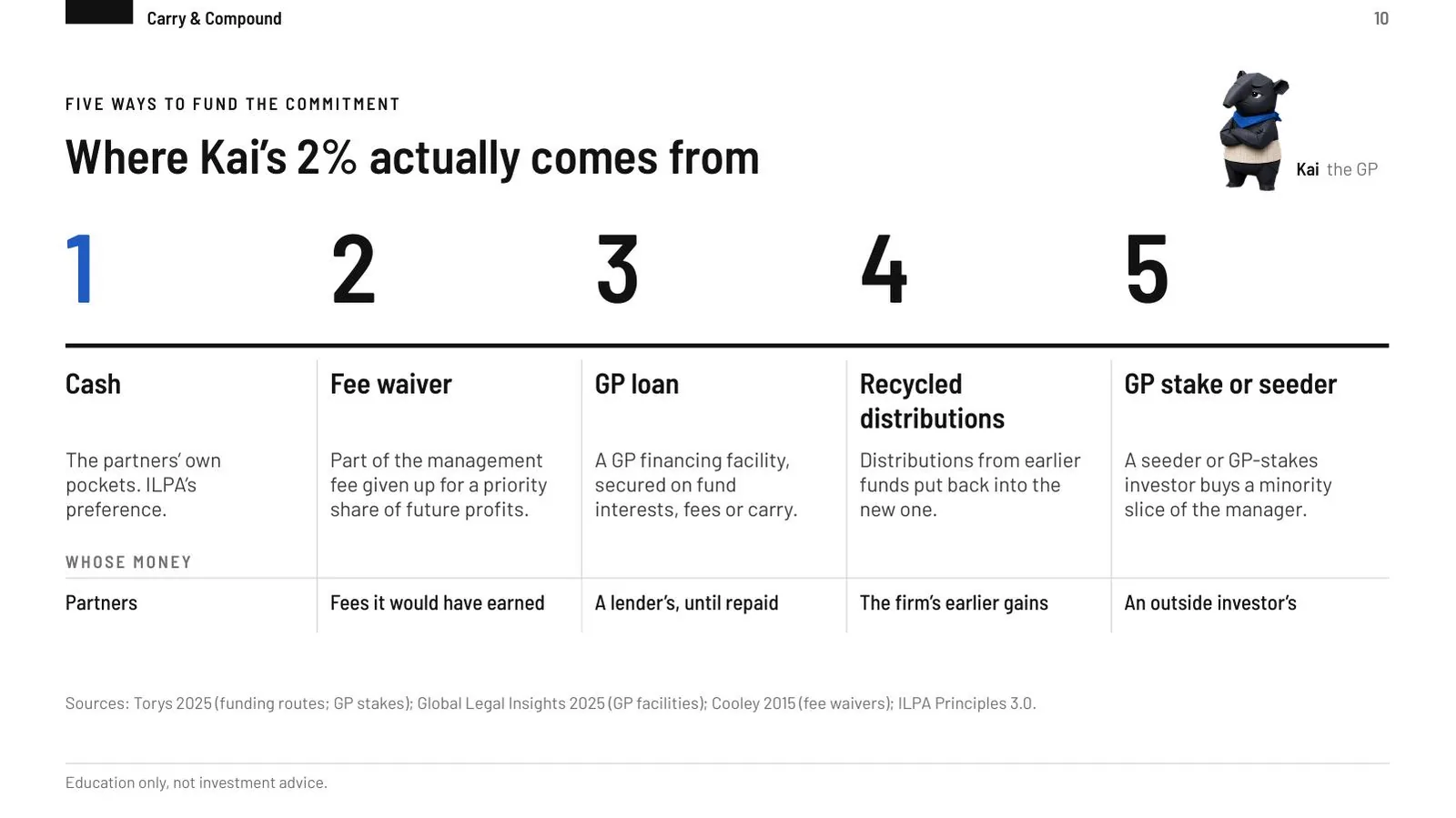
Each route counts toward the headline. Each changes how much the team really has at risk.
Cash
The partners’ own money, paid in like any LP. What ILPA prefers.
PartnersFee waiver
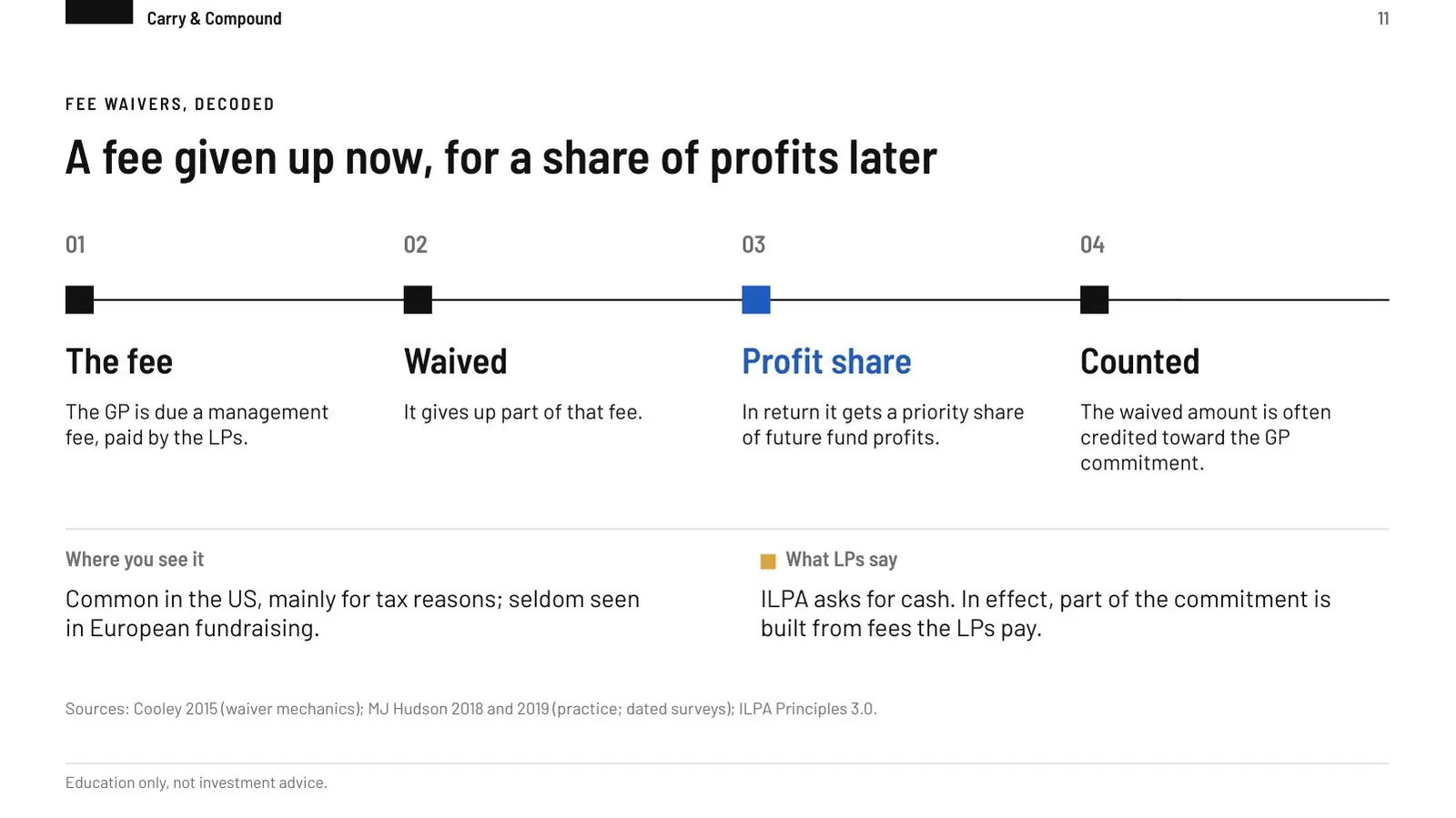
The manager gives up part of its fee for a priority share of future profits. Largely a US tax construct; seldom seen in Europe.
Fees it would have earnedGP loan
A facility secured on the GP’s fund interests, fees or carry, used to meet capital calls.
A lenderRecycled distributions
Proceeds from earlier funds rolled into the next one. Only as good as what has actually been paid out.
Earlier fundsGP stake or seeder
An outside investor buys a minority slice of the manager for a lasting share of fees or carry.
An outside ownerSources: ILPA Principles 3.0; Torys (2025); Global Legal Insights (2025); Cooley (2015); MJ Hudson (2018, 2019).
Same 2%, different alignment|Illustrative
One headline 2%, three readings
A hypothetical US$300m “Fund I”, not a real fund. Worked through step by step in Part B of the worksheet.
Hypothetical figures for illustration only. Not data on any real fund.
From the slides
Inside the briefing
Charts are redrawn from the published numbers, with the source on every slide.
Free download
Take the worksheet to your next fund meeting
The checklist, the worked example, a mini waterfall and the regional comparison, in one printable file.
Sources
Where the numbers come from
Cited and paraphrased. Figures are as published at the date shown and may since have changed. Tax treatment varies by country.
- Carta, Fund Economics Report 2025 (Dec 2025). About 2,000 US-domiciled funds administered on Carta; skews to smaller and newer managers. carta.com/data/fund-economics-report-2025/
- ILPA, Principles 3.0 (2019), “GP Commitment and Ownership” and glossary. ilpa.org/wp-content/uploads/2019/06/ILPA-Principles-3.0_2019.pdf
- ILPA, Model LPA (Whole of Fund) Term Sheet (updated July 2020). ilpa.org/
- Proskauer, Fundraising Terms and Trends in European Buyout Funds (2024): 71 funds raised 2022–23. www.proskauer.com/uploads/buyout-fundraising-europe-2024
- Torys LLP, Creative capital: how sponsors are funding increasingly large GP commitments (Oct 2025). www.torys.com/en/our-latest-thinking/publications/2025/10/how-sponsors-are-funding-increasingly-large-gp-commitments
- Torys LLP, To stake or not to stake, Torys Quarterly (Q1 2025). www.torys.com/our-latest-thinking/torys-quarterly/q1-2025/gp-staking-vs-alternative-liquidity-solutions
- Metrick, A. and Yasuda, A. (2010), “The Economics of Private Equity Funds”, Review of Financial Studies 23(6). doi.org/10.1093/rfs/hhq020
- Cooley, IRS Issues Long-Awaited Proposed Regulations on Management Fee Waivers (July 2015). www.cooley.com/news/insight/2015/irs-issues-longawaited-proposed-regulations-on-management-fee-waivers
- MJ Hudson via Mondaq, US vs European fund terms (2018) and GP/LP alignment (2019). www.mondaq.com/uk/maprivate-equity/688504/
- Bain & Company, Asia-Pacific Private Equity Report 2026 (Mar 2026). www.bain.com/insights/asia-pacific-private-equity-report-2026/
- Alternative Credit Investor, on Corpay’s Lender Book Report (Apr 2026). alternativecreditinvestor.com/2026/04/23/growth-in-demand-for-gp-financing-not-translating-to-even-access/