

Private markets, explained from both sides of the tableEducation only. Not investment advice.

Private markets, explained

Learn how private markets really work.

Who pays, who decides, and where the money actually goes. Short, sourced briefings on private equity, venture, credit and secondaries, told from both sides of the table by three folded-paper characters.

Global lens: United States, Europe and Asia-Pacific. Education only, never a recommendation.

  • Private equity
  • Venture capital
  • Private credit
  • Secondaries
  • LPs & fundraising
  • GP economics
  • Family offices
  • Fund structuring
  • Transition finance

New briefing|GP economics

Start here

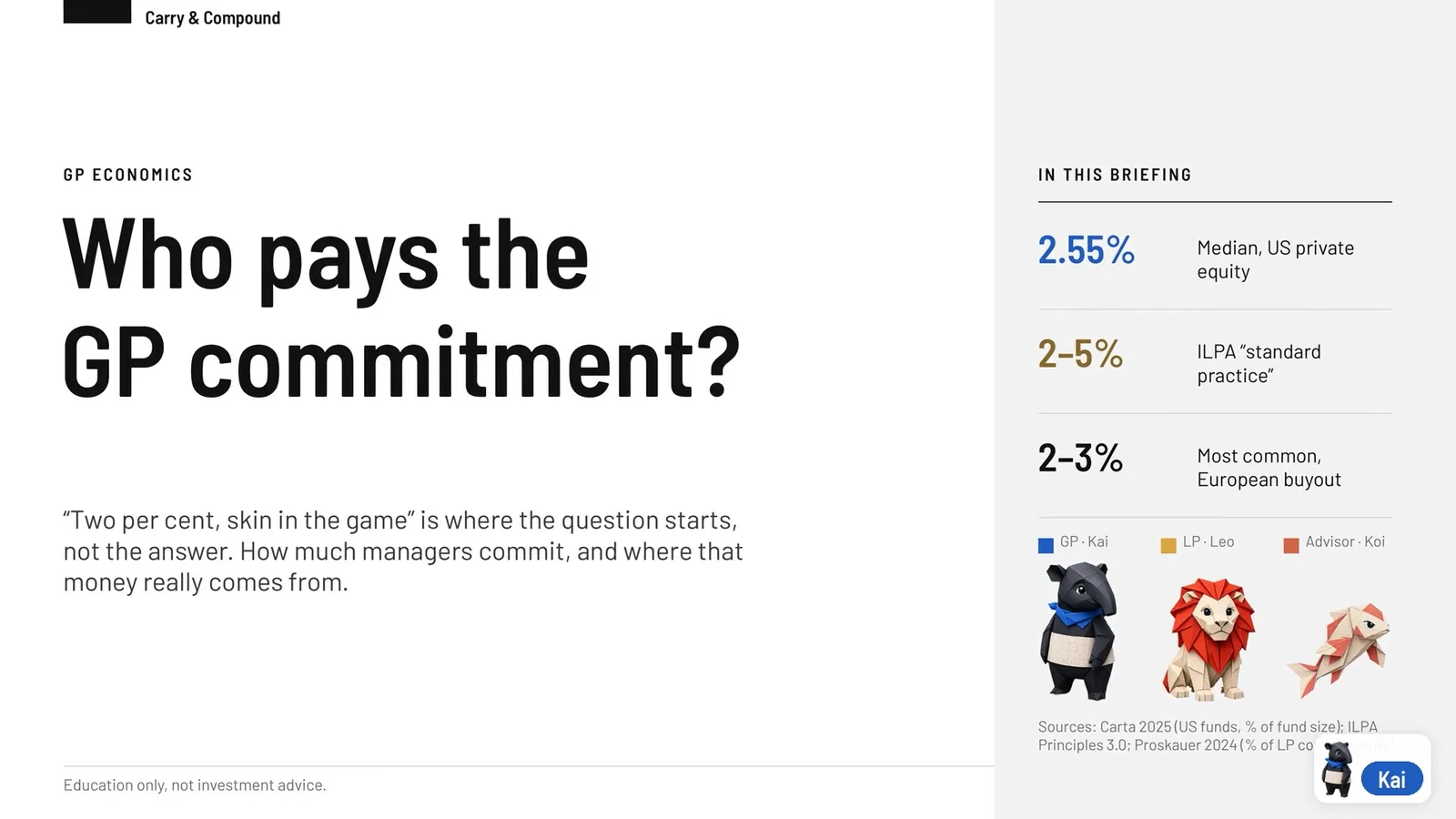
“Two per cent, skin in the game” is where the question starts, not the answer.

Meet the cast

Three seats at the table

Every deal has a manager, an investor and someone keeping score. Our cast plays those parts, so you hear each side argue its case.

Koi, a folded-paper koi fish in coral and cream, swimmingKoi curled, gesturing

The Guide · lead presenter

Koi

A folded-paper koi who sets up the question, walks through the numbers and keeps score between the two seats. She closes with Koi’s Take: a short, labelled, sourced view that weighs both sides. A guide, never an adviser.

“Two per cent of what?”

LeadsShort Version · Source Check · Koi’s Take · Ask Koi

Sits at the head of the table and keeps score.

Kai, a folded-paper tapir in black and cream wearing a blue scarfKai with arms crossed

The GP · general partner

Kai

A paper tapir in a blue scarf. Raises the fund, finds and runs the deals, earns the fee and the carry, and explains how it all looks from the manager’s side, including where the incentives pull.

“Judge me at the end of the fund, not the start.”

LeadsFrom the GP Seat · Kai’s Whiteboard · How a Fund Gets Built

Speaks for the people who run the money.

Leo, a folded-paper lion with a red mane, sittingLeo waving

The LP · limited partner

Leo

A paper lion with a red mane. Pension, endowment, insurer, sovereign fund or family office: the capital behind the fund, and the one who asks the awkward questions everyone else is thinking.

“Net, please. Not gross.”

LeadsThe Awkward Question · Leo’s Checklist · Read the Fine Print

Speaks for the people whose money it is.

Topic areas

The whole private-markets map

We’re building the library one briefing at a time. Topics are named, not numbered, and grow as the series does.

Private equity

Buyouts from the inside: how deals are funded, run and exited, and who gets paid when.

Planned

Venture capital

Fund maths, power laws, ownership targets, and why most of the return sits in a few companies.

Planned

Private credit

Direct lending, unitranche and asset-based finance: where the yield comes from, and the risks.

Planned

Secondaries

LP stake sales, continuation vehicles and GP-led deals, from both the buyer’s and seller’s side.

Planned

LPs and fundraising

How pensions, endowments, insurers and sovereigns pick managers, and what due diligence looks like.

Planned

GP economics

Fees, carry, hurdles, catch-ups and the GP commitment. Who pays, and who really carries the risk.

First briefing out

Family offices

Single and multi-family offices: governance, direct deals, co-investment and access.

Planned

Fund structuring

Limited partnerships, feeders, parallel funds and the jurisdictions behind them.

Planned

Transition finance

Funding the shift to lower-carbon economies: blended finance, impact claims and what’s measurable.

Planned

Try it|Interactive

Who funds the GP commitment?

Pick a fund size and a GP commitment, then split it between cash, a fee waiver and a loan. See how much is really the team’s own money.

GP commitment calculator

2.0% headline→0.4% own money

The briefing’s hypothetical US$300m Fund I, rebuilt as a calculator you can play with. Runs in your browser; nothing is stored or sent.

Open the calculator

Education only. Hypothetical inputs, not data on any real fund.

How we teach

Sourced. Checked. Balanced.

The rules every briefing follows before it goes out.

“If a number can’t be traced to a source, it doesn’t go on screen.”

Our house rule for every slide, video and worksheet.

Koi, curled and gesturing

Sourced

Every figure carries a source line: the publisher, the year and what was measured. Industry data, law-firm surveys and academic papers, cited and paraphrased.

Fact-checked

Each claim is logged and checked against the original. Anything we can’t confirm is labelled, or left out.

Balanced

The GP and the LP both get their say. Opinion is marked as opinion (that’s Koi’s Take), and kept apart from fact.

Global

Practice differs by region, and most data is American. We show where the US, Europe and Asia agree, where they don’t, and where data is thin.

United StatesEuropeAsia-Pacific

Free download

The GP commitment worksheet

A practical companion to the first briefing. Use it the next time you read a fund deck, a PPM or an LPA. About 40 minutes. Every fund in it is hypothetical.

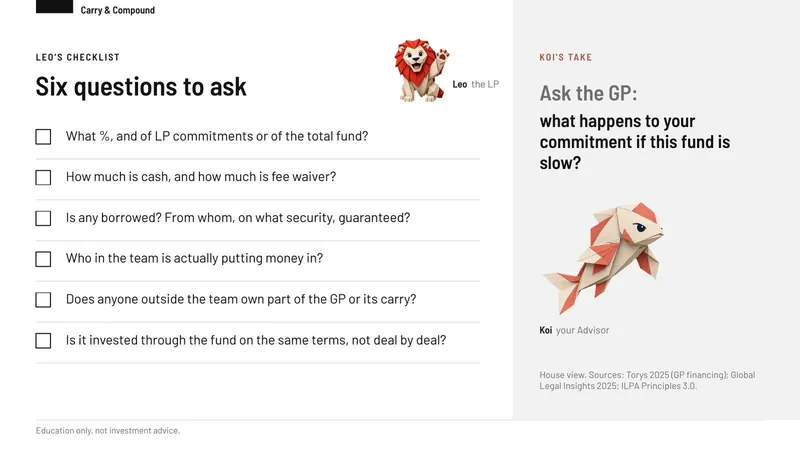
  • Part AA due-diligence checklist: size, form, financing and who really pays
  • Part BWorked example: from a 2% headline to the GP’s own money
  • Part CA mini waterfall: does the hurdle actually protect you?
  • Part DOne fund, three home markets: US, Europe and Asia-Pacific
Preview: the six-question checklist from the briefing

Preview only. Nothing was sent: the email list isn't connected yet.

Plain English, no spam. One email when a new briefing is out.

Courses · coming soon

Go deeper, at your own pace

Self-paced courses built on the same rules as the videos: sourced numbers, worked examples and worksheets you can reuse at work. The free briefings stay free.

  • Secondaries from the LP’s seat In development
  • GP economics: fees, carry and alignment Planned
  • Inside an LP’s due diligence Planned
Koi swimming

Preview only. Nothing was sent: the email list isn't connected yet.

Newsletters|Free

Pick what lands in your inbox

Four short newsletters. Tick the ones you want, choose how often, and change your mind any time.

Fortnightly

The Briefing

Every new explainer, with the video, the worksheet and Koi’s Take.

Weekly

Term Sheet Tuesday

One fund term, explained in under 200 words, with a line from each seat.

Monthly

Deal Desk

Public private-markets news, explained and sourced. No tips, no live deals.

Only when there’s news

Course updates

The waitlist: hear first when a course opens, and help shape it.

Choose your newslettersPlain English, sourced, no spam. Education only.

FAQ

Questions, answered

Something else? Write to hello@carrycompound.com.

Is this investment advice?

No. Everything we publish is general education about how private markets work. We don’t recommend any fund, manager, security or strategy, and nothing here takes your circumstances into account. Speak to a licensed adviser before you make decisions.

Who is behind Carry & Compound?

Carry & Compound is an independent, anonymous education brand. The presenters are characters, by design: the focus stays on the material, not on a personality. Every briefing is researched, sourced and checked before it is published.

Are Koi, Kai and Leo AI?

They are folded-paper characters. Their voices are synthetic (AI-generated) voices. The scripts are written for each briefing and checked against the cited sources, and every number on screen carries its source.

Who is it for?

Anyone who needs to understand private markets without sitting inside a fund every day: allocators and their teams, advisers, founders raising money, finance students and professionals moving across from public markets.

Why a US, Europe and Asia lens?

Market practice differs by region, and most public data is American. Where the numbers or the norms differ, we say so, and we say when there simply isn’t good data.

Do you talk about specific funds or managers?

No. We explain structures, terms and trade-offs. Worked examples use hypothetical funds, and we don’t comment on live fundraisings.

Will there be paid courses?

Yes, later. The videos, worksheets and quizzes stay free. Join the waitlist and you’ll hear first when a course opens.

How current are the numbers?

Each figure is dated and linked to its source. Market data moves, so check the date on the source line before relying on a number.